Loading...
Please wait while we prepare your experience
Loading...
Please wait while we prepare your experience
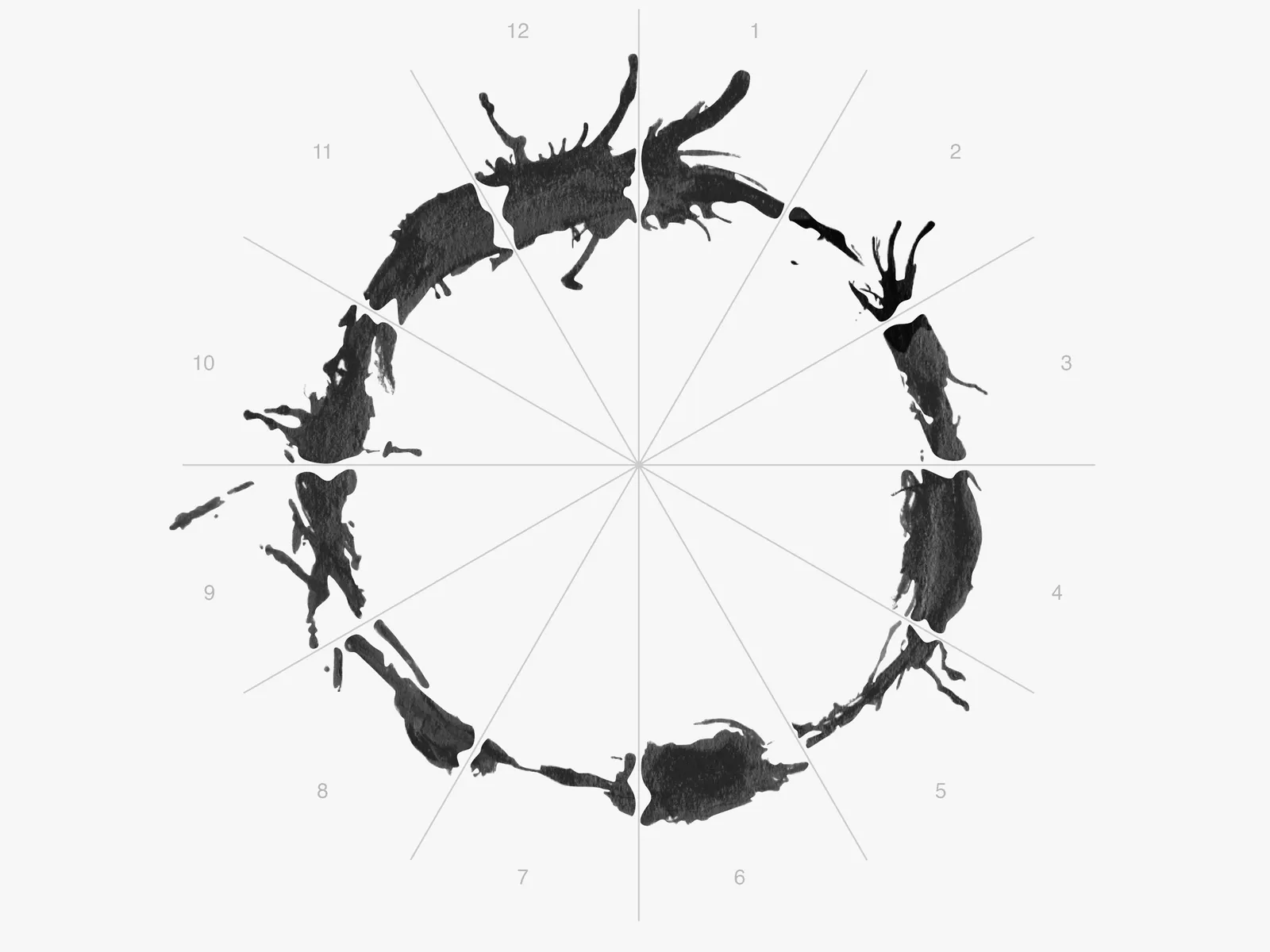
On spatial encoding, alien semiotics, and the computational universe of possible writing systems.
Human writing systems are fundamentally one-dimensional. Whether read left-to-right, right-to-left, or top-to-bottom, text unfolds as a sequence—a stream of symbols parsed in order. This linearity mirrors speech: phonemes arranged temporally, decoded one after another.
But screens are not pages. The web is an inherently two-dimensional medium. Yet digital interfaces largely replicate the sequential logic of print—paragraphs, bullet points, scrolling text. The spatial dimension of the screen remains underutilised for information encoding.
What would it mean to convey information in two dimensions? Not text arranged spatially, but symbols where spatial relationships constitute meaning—where position, proximity, and form encode semantics simultaneously rather than sequentially.
The 2016 film Arrival, directed by Denis Villeneuve, presented this exact problem. The alien heptapods communicate through circular logograms—complete thoughts rendered as ink-like symbols, perceived holistically rather than read linearly.
Director Villeneuve approached Stephen Wolfram to consult on the linguistic and computational aspects of the alien language. Wolfram, creator of Mathematica, Wolfram|Alpha, and author of A New Kind of Science, brought a unique perspective: the idea that the universe of possible computational systems is vast, and human mathematics represents only a small, historically contingent sample of it.
In a 2016 interview with Space.com, Wolfram articulated this directly:
"The things we've been interested in in math are just samplings of the set of all possible mathematical facts... The particular ones that one has sampled are very dependent on the detailed history of a civilization."
This insight applies equally to writing systems. Human scripts evolved to represent speech—a fundamentally sequential medium. An alien species with different perceptual apparatus, or one that evolved visual communication before auditory, might develop writing that encodes information spatially from the outset.
Stephen Wolfram's son, Christopher Wolfram, was commissioned to build the actual code that appears on screen in Arrival. His task: create computational tools to analyse the fictional logogram language and generate visualisations for the film's scientists to interact with.
Christopher's approach, documented in a Wolfram U course titled "The Code Behind Arrival", treated the logograms as computational objects. Using Wolfram Language, he built tools to:
The code demonstrated that even fictional writing systems become tractable when treated computationally—as rule-governed generative systems rather than arbitrary drawings.
// Wolfram Language pseudocode (conceptual)
// Analysing logogram structure

logograms = Import["logograms/*.png"];
contours = ImageContour /@ logograms;
symmetryScores = RotationalSymmetry /@ contours;
densityMaps = ImageData[GaussianFilter[#, 5]] & /@ logograms;

// Cluster by structural similarity
clusters = FindClusters[logograms,
  DistanceFunction -> ImageDistance,
  Method -> "KMeans"
];Wolfram's broader research programme—exploring the computational universe through cellular automata, Turing machines, and simple programs—provides a framework for thinking about emergent writing systems.
In A New Kind of Science, Wolfram demonstrated that extremely simple rules can generate extraordinary complexity. Rule 30, a one-dimensional cellular automaton with only three inputs and two states, produces patterns indistinguishable from randomness yet entirely deterministic. Rule 110 is proven to be Turing-complete—capable, in principle, of universal computation.
If simple rules can generate such complexity, they can also generate writing. Not writing that humans designed, but writing that emerges—symbols with internal structure, consistency, and the capacity to encode information, even if that encoding is alien to human parsing.
// Elementary Cellular Automaton (Rule 30)
// Generates complex, pseudorandom patterns from simple rules

function rule30(left, center, right) {
  const neighborhood = (left << 2) | (center << 1) | right;
  const rule = 30; // Binary: 00011110
  return (rule >> neighborhood) & 1;
}

function generateCA(width, height, seed) {
  let grid = Array(height).fill(null).map(() => Array(width).fill(0));

  // Seed initial row
  grid[0] = seedToRow(seed, width);

  // Evolve
  for (let y = 1; y < height; y++) {
    for (let x = 0; x < width; x++) {
      const left = grid[y-1][(x - 1 + width) % width];
      const center = grid[y-1][x];
      const right = grid[y-1][(x + 1) % width];
      grid[y][x] = rule30(left, center, right);
    }
  }

  return grid;
}
When bounded within a glyph-sized container, cellular automata produce forms that read as symbols—structured, non-random, yet unfamiliar. Different rules produce different visual families. Different seeds produce different instances within a family.
The fundamental shift in two-dimensional information encoding is from sequential parsing to simultaneous perception.
| Property | 1D (Linear Text) | 2D (Spatial Glyphs) |
|---|---|---|
| Processing | Sequential, left-to-right | Holistic, gestalt perception |
| Time | Unfolds over reading duration | Entire meaning available instantly |
| Relationships | Adjacency (before/after) | Proximity, symmetry, containment |
| Density | Limited by line length | Potentially higher per symbol |
| Ambiguity | Resolved by context (later words) | Resolved by spatial relationships |
Human vision processes images holistically before analytically. The gestalt principles—proximity, similarity, continuity, closure—describe how the visual system groups elements into perceived wholes. A 2D writing system leverages this: meaning emerges from pattern recognition rather than sequential decoding.
The Arrival logograms exemplify this. A heptapod symbol is not "read" from any starting point. It is perceived as a complete thought, with modifying elements positioned spatially relative to a core meaning.
Several algorithmic families can generate forms suitable for a 2D writing system. Each produces distinct visual qualities.
As demonstrated above, elementary CA generate complex patterns deterministically. The visual aesthetic is digital, crystalline—grids and edges. Wolfram's research catalogued 256 elementary rules; each produces a distinct visual signature.
// Generate glyph from CA with semantic seeding
function caGlyph(seed, rule = 30, size = 32) {
const grid = generateCA(size, size, seed);
// Convert to SVG path
let path = '';
for (let y = 0; y < size; y++) {
for (let x = 0; x < size; x++) {
if (grid[y][x] === 1) {
path += `M${x} ${y} h1 v1 h-1 Z `;
}
}
}
return `L-systems encode recursive growth—rules that rewrite strings, interpreted as drawing instructions. Originally modelling plant morphology, they produce organic, branching forms with fractal self-similarity.
// L-System with turtle graphics interpretation
const lsystemRules = {
  'F': 'FF+[+F-F-F]-[-F+F+F]',  // Tree-like branching
};

function evolve(axiom, rules, iterations) {
  let result = axiom;
  for (let i = 0; i < iterations; i++) {
    result = result.split('').map(c => rules[c] || c).join('');
  }
  return result;
}

function interpret(instructions, angle = 25) {
  const stack = [];
  let x = 0, y = 0, theta = -90;
  let path = `M ${x} ${y}`;

  for (const char of instructions) {
    switch (char) {
      case 'F':
        x += Math.cos(theta * Math.PI / 180) * 5;
        y += Math.sin(theta * Math.PI / 180) * 5;
        path += ` L ${x} ${y}`;
        break;
      case '+': theta += angle; break;
      case '-': theta -= angle; break;
      case '[': stack.push({ x, y, theta }); break;
      case ']':
        const state = stack.pop();
        x = state.x; y = state.y; theta = state.theta;
        path += ` M ${x} ${y}`;
        break;
    }
  }

  return path;
}

// Generate: interpret(evolve('F', lsystemRules, 3), 25)
L-systems offer precise control over complexity through iteration depth. Low iterations produce simple geometric forms; higher iterations yield intricate, glyph-like structures.
Gray-Scott and Turing patterns simulate chemical diffusion, producing organic spots, stripes, and labyrinthine forms. The aesthetic is biological—coral, lichen, fingerprints.
// Gray-Scott Reaction-Diffusion (simplified)
// Requires iterative simulation—expensive but distinctive

const config = {
  feed: 0.055,    // Feed rate
  kill: 0.062,    // Kill rate
  dA: 1.0,        // Diffusion rate A
  dB: 0.5,        // Diffusion rate B
};

function stepSimulation(gridA, gridB, config) {
  const { feed, kill, dA, dB } = config;
  const newA = [], newB = [];

  for (let y = 0; y < height; y++) {
    newA[y] = []; newB[y] = [];
    for (let x = 0; x < width; x++) {
      const a = gridA[y][x];
      const b = gridB[y][x];
      const lapA = laplacian(gridA, x, y);
      const lapB = laplacian(gridB, x, y);
      const reaction = a * b * b;

      newA[y][x] = a + (dA * lapA - reaction + feed * (1 - a));
      newB[y][x] = b + (dB * lapB + reaction - (kill + feed) * b);
    }
  }

  return [newA, newB];
}
Reaction-diffusion is computationally expensive. For web deployment, pre-computed frames or WebGL shaders are necessary.
Following Christopher Wolfram's approach to the Arrival logograms, a hybrid system combines multiple generative methods:
// Hybrid glyph generator inspired by Wolfram's logogram analysis
function generateHybridGlyph(seed) {
  // 1. Core structure: L-system skeleton
  const skeleton = interpret(evolve('F', treeRules, 2), 60);

  // 2. Texture: CA-based fill pattern
  const texture = generateCA(16, 16, seed);

  // 3. Boundary: Circular containment (like Arrival logograms)
  const radius = 50;
  const boundary = `M ${radius} 0 A ${radius} ${radius} 0 1 1 ${radius} 0.01 Z`;

  // 4. Composite: Mask skeleton with texture, contain within boundary
  return {
    skeleton,
    texture: textureToPattern(texture),
    boundary,
    composite: clipPathComposite(skeleton, texture, boundary)
  };
}The question of meaning: can emergent glyphs encode actual information, or are they purely decorative?
Wolfram's observation about the "computational universe" suggests a middle path. Glyphs need not be human-readable to be information-bearing. If generation is deterministic—same seed produces same glyph—then the glyph is the information, encoded visually.
// Deterministic route-to-glyph mapping
function glyphForRoute(pathname) {
  const hash = cyrb53(pathname);  // Fast, deterministic hash
  const seed = hash % 100000;
  const rule = 30 + (hash % 90);  // Rules 30-119

  return caGlyph(seed, rule, 32);
}

// cyrb53: fast string hash
function cyrb53(str, seed = 0) {
  let h1 = 0xdeadbeef ^ seed, h2 = 0x41c6ce57 ^ seed;
  for (let i = 0; i < str.length; i++) {
    const ch = str.charCodeAt(i);
    h1 = Math.imul(h1 ^ ch, 2654435761);
    h2 = Math.imul(h2 ^ ch, 1597334677);
  }
  h1 = Math.imul(h1 ^ (h1 >>> 16), 2246822507);
  h2 = Math.imul(h2 ^ (h2 >>> 13), 3266489909);
  return 4294967296 * (2097151 & h2) + (h1 >>> 0);
}The result: visitors cannot "read" the glyphs, but consistent rules ensure internal logic. Patterns emerge across pages. The writing system is alien but not arbitrary.
Where might emergent glyphs appear within a website's visual identity?
| Location | Behaviour | Encoding |
|---|---|---|
| Page headers | Static, route-seeded | Unique identity per page |
| Section dividers | Interpolate between adjacent glyphs | Transitional meaning |
| Loading states | Animate generation process | Meaning emerging in real-time |
| Background | Tiled CA patterns, slowly evolving | Ambient complexity |
| Navigation | Glyphs as route indicators | Functional wayfinding |
| Error states | Fragmented or corrupted glyphs | Semantic breakdown |
| Favicon | Simplified site glyph | Brand mark |
Generative systems risk blocking the main thread. Mitigation strategies:
// Build-time glyph generation (Next.js example)
// scripts/generate-glyphs.ts

import { writeFileSync } from 'fs';
import { getAllRoutes } from '../lib/routes';
import { glyphForRoute } from '../lib/glyph-generator';

const routes = getAllRoutes();
const manifest = {};

for (const route of routes) {
  manifest[route] = glyphForRoute(route);
}

writeFileSync(
  './public/glyphs/manifest.json',
  JSON.stringify(manifest, null, 2)
);

// Runtime: import manifest, lookup by route
// No generation cost at runtime for known routesGlyphs that "mean something" but cannot be read present design tensions:
The goal is ambient mystery—glyphs exist in peripheral vision, reward attention, but do not gate navigation or comprehension.
Several design questions remain unresolved:
These questions echo Wolfram's observation about interestingness being context-dependent. What makes a glyph system compelling depends on the site's purpose and audience.
Human writing evolved to transcribe speech—a solution to a specific problem in a specific context. The computational universe contains countless alternative solutions: writing systems that encode meaning spatially, holistically, or through emergent structural relationships.
Wolfram's work—both Stephen's theoretical framework and Christopher's applied code for Arrival—demonstrates that alien writing is not mysticism but computation. Given rules, a generative system produces symbols with internal logic. Whether that logic is human-readable is a separate question from whether it is meaningful.
For a website built around emergence and complex systems, an emergent writing system is not decoration. It is demonstration: structure arising from simple rules, meaning encoded in two dimensions, the computational universe made visible.